
Banking Average Salaries in Dakar 2026
How much money does a person working in Banking make in Dakar?
LOW
128,000
XOF AVERAGE
409,000
XOF HIGH
834,000
XOF
A person working in Banking in Dakar typically earns around 409,000 XOF. Salaries range from 128,000 XOF (lowest average) to 834,000 XOF (highest average, actual maximum salary is higher).
Salary Variance
The provided figure represents the median compensation that encompasses housing, transportation, and other perks. The salaries within the Banking domain in Dakar exhibit significant discrepancies across various professions. In case you seek information about the remuneration of a specific position, please refer to the salaries listed below for respective job titles.
Salaries for specific jobs
| Job Title | Average Salary |
| Banking | |
| AML Analyst | 567,000 XOF |
| Assistant Bank Branch Manager | 498,000 XOF |
| Assistant Bank Manager | 614,000 XOF |
| ATM Manager | 551,000 XOF |
| ATM Service Technician | 146,000 XOF |
| Bank Accounts Analyst | 205,000 XOF |
| Bank Accounts Collector | 129,000 XOF |
| Bank Accounts Controller | 269,000 XOF |
| Bank Accounts Executive | 424,000 XOF |
| Bank Accounts Manager | 473,000 XOF |
| Bank Auditing Manager | 500,000 XOF |
| Bank Branch Manager | 638,000 XOF |
| Bank Branch Operations Coordinator | 303,000 XOF |
| Bank Clerk | 126,000 XOF |
| Bank Client Service Associate | 173,000 XOF |
| Bank Collector | 135,000 XOF |
| Bank Compliance Specialist | 331,000 XOF |
| Bank Manager | 738,000 XOF |
| Bank Operational Risk Manager | 742,000 XOF |
| Bank Operations Head | 816,000 XOF |
| Bank Operations Officer | 310,000 XOF |
| Bank Operations Specialist | 491,000 XOF |
| Bank Process Manager | 437,000 XOF |
| Bank Product Manager | 499,000 XOF |
| Bank Programme Manager | 543,000 XOF |
| Bank Project Manager | 606,000 XOF |
| Bank Propositions Manager | 538,000 XOF |
| Bank Quantitative Analyst | 377,000 XOF |
| Bank Regional Manager | 814,000 XOF |
| Bank Regional Risk Officer | 414,000 XOF |
| Bank Relationship Manager | 574,000 XOF |
| Bank Relationship Officer | 261,000 XOF |
| Bank Sustainability Analyst | 437,000 XOF |
| Bank Teller | 134,000 XOF |
| Banker | 279,000 XOF |
| Banking Business Analyst | 409,000 XOF |
| Banking Business Development Officer | 256,000 XOF |
| Banking Business Planning Executive | 554,000 XOF |
| Banking Data Analyst | 477,000 XOF |
| Banking Product Manager | 486,000 XOF |
| Banking Reference Data Manager | 450,000 XOF |
| Banking Regulatory Compliance Officer | 471,000 XOF |
| Banking Risk Analyst | 410,000 XOF |
| Banking Technical Analyst | 217,000 XOF |
| Bankruptcy Coordinator | 281,000 XOF |
| Bill and Account Collector | 140,000 XOF |
| Blockchain Analyst | 332,000 XOF |
| Blockchain Architect | 410,000 XOF |
| Blockchain Auditor | 349,000 XOF |
| Blockchain Compliance Analyst | 383,000 XOF |
| Blockchain Consultant | 387,000 XOF |
| Blockchain Trade Facilitator | 337,000 XOF |
| Budget Analyst | 394,000 XOF |
| Capital Risk Manager | 745,000 XOF |
| Cards Marketing Manager | 485,000 XOF |
| Cash Management Manager | 687,000 XOF |
| Check Processing Manager | 540,000 XOF |
| Chief Blockchain Officer | 464,000 XOF |
| Commercial Vault Associate | 406,000 XOF |
| Corporate Banker | 283,000 XOF |
| Corporate Dealer | 436,000 XOF |
| Credit Analyst | 319,000 XOF |
| Credit and Collections Manager | 532,000 XOF |
| Credit Card Fraud Investigator | 433,000 XOF |
| Credit Portfolio Manager | 719,000 XOF |
| Credit Risk Analyst | 441,000 XOF |
| Credit Risk Associate | 416,000 XOF |
| Cryptocurrency Accountant | 261,000 XOF |
| Cryptocurrency Adviser | 488,000 XOF |
| Cryptocurrency Analyst | 389,000 XOF |
| Cryptocurrency Compliance Manager | 464,000 XOF |
| Cryptocurrency Trader | 400,000 XOF |
| Digital Banking Manager | 534,000 XOF |
| Digital Currency Analyst | 392,000 XOF |
| Direct Bank Sales Representative | 286,000 XOF |
| Exchange Control Consultant | 423,000 XOF |
| Executive Account Analyst | 381,000 XOF |
| Financial Bank Planning Consultant | 525,000 XOF |
| Financial Banking Analysis Manager | 606,000 XOF |
| Financial Banking Assistant | 189,000 XOF |
| Financial Banking Systems Manager | 574,000 XOF |
| Foreign Exchange Manager | 591,000 XOF |
| Fraud Analyst | 435,000 XOF |
| Fraud Detection Associate | 281,000 XOF |
| Fraud Detection Manager | 653,000 XOF |
| Fraud Detection Supervisor | 361,000 XOF |
| Internal Bank Audit Manager | 769,000 XOF |
| Internal Bank Auditor | 394,000 XOF |
| Internal Private Banker | 294,000 XOF |
| International Banking Manager | 800,000 XOF |
| Investment Banking Analyst | 582,000 XOF |
| Loan Analyst | 394,000 XOF |
| Loan Area Manager | 503,000 XOF |
| Loan Audit Team Leader | 471,000 XOF |
| Loan Branch Manager | 448,000 XOF |
| Loan Business Development Officer | 257,000 XOF |
| Loan Clerk | 144,000 XOF |
| Loan Collection and Recovery Manager | 499,000 XOF |
| Loan Collection Manager | 470,000 XOF |
| Loan Collector | 131,000 XOF |
| Loan Examiner | 168,000 XOF |
| Loan Officer | 153,000 XOF |
| Loan Processing Manager | 441,000 XOF |
| Loan Processor | 177,000 XOF |
| Loan Quality Assurance Auditor | 423,000 XOF |
| Loan Quality Assurance Manager | 453,000 XOF |
| Loan Quality Assurance Representative | 290,000 XOF |
| Loan Review Manager | 466,000 XOF |
| Loan Team Leader | 400,000 XOF |
| Loans Manager | 516,000 XOF |
| Mortgage Advisor | 292,000 XOF |
| Mortgage Collection Manager | 474,000 XOF |
| Mortgage Collector | 127,000 XOF |
| Mortgage Credit Analyst | 220,000 XOF |
| Mortgage Credit Manager | 445,000 XOF |
| Mortgage Development Manager | 541,000 XOF |
| Mortgage Document Reviewer | 177,000 XOF |
| Mortgage Funding Manager | 506,000 XOF |
| Mortgage Operations Manager | 680,000 XOF |
| Mortgage Payment Processing Clerk | 159,000 XOF |
| Mortgage Processing Manager | 476,000 XOF |
| Mortgage Processor | 180,000 XOF |
| Mortgage Quality Assurance Auditor | 397,000 XOF |
| Mortgage Quality Assurance Manager | 437,000 XOF |
| Mortgage Servicing Clerk | 134,000 XOF |
| Mortgage Servicing Manager | 451,000 XOF |
| Mortgage Underwriter | 174,000 XOF |
| Online Banking Manager | 723,000 XOF |
| Open Banking Strategist | 413,000 XOF |
| Payment Processing Clerk | 142,000 XOF |
| Personal Banker | 292,000 XOF |
| Personal Banking Advisor | 297,000 XOF |
| Phone Banker | 203,000 XOF |
| Private Banker | 278,000 XOF |
| Reconciliation and Investigation Specialist | 336,000 XOF |
| Tax Officer | 232,000 XOF |
| Teller | 142,000 XOF |
| Trade Officer | 171,000 XOF |
| Trade Product Manager | 471,000 XOF |
| Trader | 189,000 XOF |
| Treasury Operations Officer | 361,000 XOF |
| Wealth Management Advisor | 603,000 XOF |

Banking Jobs Pay Scale and Salaries in Dakar
Median Salary, maximum and minimum salary, minimum wage, starting salary, and the salary range
Salary Range, Minimum Wage, and Starting Salary
Salaries in Banking in Dakar range from 128,000 XOF (starting average salary) to 834,000 XOF (maximum average salary, actual maximum is higher). To clarify, the number presented is not the legally mandated minimum wage. Rather, it represents the lowest figure reported in a salary survey that involved thousands of participants and professionals from across the entire country.
Median Salary
The median income in the field of Banking is 363,000 XOF, implying that half of the workforce in Dakar earns less than this figure, and the other half earns more. It represents the central value of salaries. As a rule of thumb, you would prefer to be part of the group earning above the median wage, situated on the right-hand side of the salary distribution chart.
Percentiles and Salary Scale
Two values that are highly correlated with the median are the 25th and 75th percentiles. By examining the salary distribution diagram, it is possible to determine that 25% of individuals employed in Banking in Dakar earn less than 271,000 XOF, while 75% of them earn more. Additionally, the diagram reveals that 75% of individuals earn less than 447,000 XOF, while 25% earn more than that.
Pay Scale Structure
Data was regrouped into brackets to provide a better understanding of what salaries can be expected. This approach was deemed more accurate than relying solely on the average salary, as it offers greater insights into the distribution of salaries in the field of Banking in Dakar. The analysis revealed that roughly 65% of all reported salaries fell within the range of 183,000 XOF to 336,000 XOF. Approximately 20% of salaries were below the 183,000 XOF mark, while 10% ranged from 336,000 XOF to 406,000 XOF. Only 5% of individuals earned a gross salary of 406,000 XOF or higher.

Salary Comparison by Years of Experience
How does a person's salary progress over time?
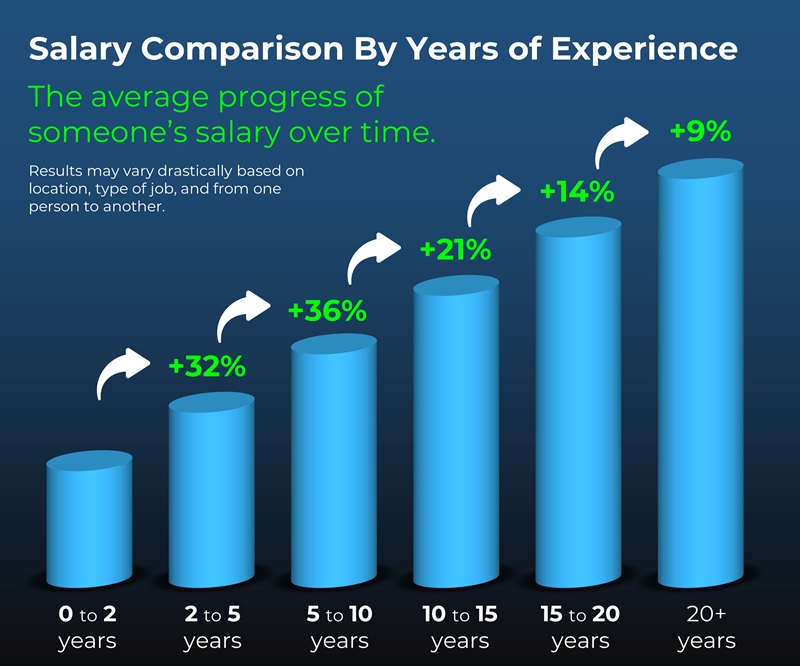
The experience level is the most important factor in determining the salary. Naturally, the more years of experience the higher the wage.
Generally speaking, employees in Banking in Dakar having experience from two to five years earn on average 32% more than freshers and juniors across all industries and disciplines.
Professionals with experience of more than five years tend to earn on average 36% more than those with five years or less of work experience.
As you hit the ten years mark, the salary increases by 21% and an additional 14% for those who have crossed the 15 years mark.
Those figures are presented as guidelines only. The numbers become more significant if you consider one job title at a time.
Salary Comparison By Education
How does the education level affect your salary?
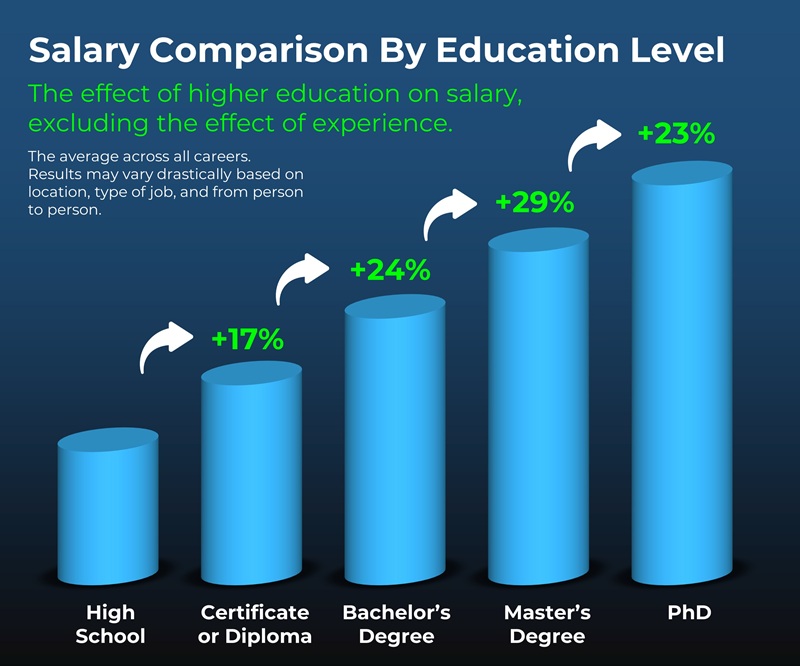
It is well known that higher education equals a bigger salary, but how much more money can a degree add to your income?
We compared the salaries of professionals at the same level but with different college degree levels across many jobs in Banking in Dakar, below are our findings.
Workers with a certificate or diploma earn on average 17% more than their peers who only reached the high school level.
Employees who earned a Bachelor's Degree earn 24% more than those who only managed to attain a certificate or diploma.
Professionals who attained a Master's Degree are awarded salaries that are 29% more than those with a Bachelor's Degree.
Finally, PhD holders earn 23% more than Master's Degree holders on average while doing the same job.
Is a Master's degree or an MBA worth it? Should you pursue higher education?
A Master's degree program or any post-graduate program in Senegal costs anywhere from 1.8M XOF to 5.3M XOF and lasts approximately two years. That is quite an investment.
Employees can't expect any salary increases during the study period, assuming they already have a job. In most cases, a salary review is conducted once education is completed and the degree has been attained.
Many people pursue higher education as a tactic to switch to a higher-paying job. The numbers seem to support this tactic. The average increase in compensation while changing jobs is approximately 10% more than the customary salary increment.
The decision really depends on the situation and experience among many other factors. Putting all variables aside, if a person can afford the costs of higher education then the return on investment is definitely worth it. Degree costs can be recovered roughly in a year or so.
Salary and Compensation Comparison By Gender / Banking / Dakar

Though gender should not have an effect on pay, in reality, it does. So who gets paid more: men or women? In the field of Banking in Senegal, the average difference between the salary of male and female employees is 11%.
| Male | 406,000 XOF | |
| Female | -10% | 368,000 XOF |
Average Annual Salary Increment Percentage / Banking / Dakar
How much are annual salary increments in Dakar for individuals working in Banking? How often do employees get salary raises?
Professionals working in Banking in Senegal are likely to observe a salary increase of approximately 7% every 26 months. The national average annual increment for all professions combined is 5% granted to employees every 28 months.

The term Annual Salary Increase usually refers to the increase in 12 calendar month period, but because it is rare that people get their salaries reviewed exactly on the one-year mark, it is more meaningful to know the frequency and the rate at the time of the increase.
How to calculate the salary increment percentage?
The annual salary Increase in a calendar year (12 months) can be easily calculated as follows: Annual Salary Increase = Increase Rate x 12 / Increase Frequency
Worldwide Salary Raises: All Countries and All Jobs
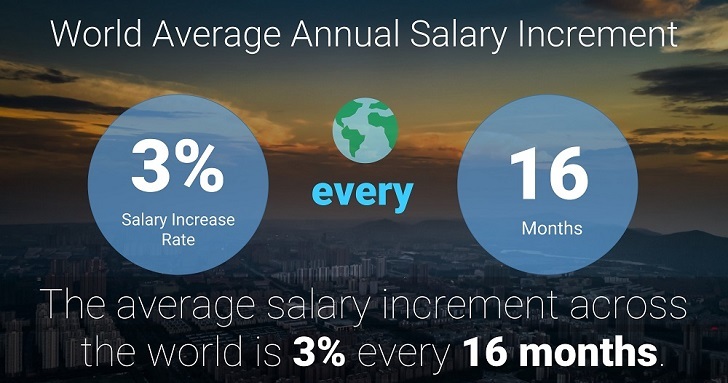
Salary Packages and Schemes
Not all compensation increases are reflected directly in the salary. Some companies offer upgraded packages to their staff instead of cash money. The figures displayed here account only for direct increments to the base salary.
Bonus and Incentive Rates / Banking / Senegal
How much and how often are bonuses being awarded?
42% of surveyed staff in Banking reported that they haven't received any bonuses or incentives in the previous year while 58% said that they received at least one form of monetary bonus.
Those who got bonuses reported rates ranging from 6% to 8% of their annual salary.
| Received Bonus | 58% | |
| No Bonus | 42% |
Types of Bonuses Considered
Individual Performance-Based BonusesThe most standard form of bonus, where the employee is awarded based on their exceptional performance.
Company Performance BonusesOccasionally, some companies like to celebrate excess earnings and profits with their staff collectively in the form of bonuses that are granted to everyone. The amount of the bonus will probably be different from person to person depending on their role within the organization.
Goal-Based BonusesGranted upon achieving an important goal or milestone.
Holiday / End of Year BonusesThese types of bonuses are given without a reason and usually resemble an appreciation token.
Bonuses Are Not Commissions!
People tend to confuse bonuses with commissions. A commission is a prefixed rate at which someone gets paid for items sold or deals completed while a bonus is in most cases arbitrary and unplanned.
What makes a position worthy of good bonuses and a high salary?
The main two types of jobs | |
| Revenue Generators | Supporting Cast |
Employees that are directly involved in generating revenue or profit for the organization. Their field of expertise usually matches the type of business. | Employees that support and facilitate the work of revenue generators. Their expertise is usually different from that of the core business operations. |
Example: | Example: |
Revenue generators usually get more and higher bonuses, higher salaries, and more frequent salary increments. The reason is quite simple: it is easier to quantify your value to the company in monetary terms when you participate in revenue generation.
Bonus Comparison by Seniority Level
Top management personnel and senior employees naturally exhibit higher bonus rates and frequencies than juniors. This is very predictable due to the inherent responsibilities of being higher in the hierarchy. People in top positions can easily get double or triple bonus rates than employees down the pyramid.
Hourly Average Wage / Banking / Dakar
The average hourly wage (pay per hour) in Banking in Dakar is 2,360 XOF.This is the rate they get paid for every worked hour.
About The Hourly Pay Rate
The hourly wage is the salary paid in one worked hour. Usually, jobs are classified into two categories: salaried jobs and hourly jobs. Salaried jobs pay a fixed amount regardless of the hours worked. Hourly jobs pay per worked hour. To convert salary into hourly wage the above formula is used (assuming 5 working days in a week and 8 working hours per day which is the standard for most jobs). The hourly wage calculation may differ slightly depending on the worked hours per week and the annual vacation allowance. The figures mentioned above are good approximations and are considered to be the standard. One major difference between salaried employees and hourly paid employees is overtime eligibility. Salaried employees are usually exempt from overtime as opposed to hourly paid staff.
What is the minimum hourly rate of pay?
The minimum pay rate per hour for people working in Banking in Dakar is 740 XOF. This is the minimum as per the gathered data in the salary survey not the minimum hourly rate mandated by law.
Salary Comparison By City
| City | Average Salary |
| Dakar | 409,000 XOF |
Government vs Private Sector Salary Comparison
Where can you get paid more, working in a private company or the government? The difference between the public or government sector salaries and the private sector salaries in Senegal is 14% on average across all career fields.
| Private Sector | 334,000 XOF | |
| Public Sector | +14% | 380,000 XOF |
Salary Statistics and Calculation Guide
What is considered to be a good and competitive salary in Banking in Dakar?
A good and competitive compensation would range anywhere between 363,000 XOF and 447,000 XOF. This is a very rough estimate. Experience and education play a very huge part in the final earnings.
Gross Salary (before tax) and Net Salary (after tax)
All salary and compensation figures displayed here are gross salary figures, that is the salary before tax deductions. Because taxes may differ across sectors and locations, it is difficult to accurately calculate the net salary after tax for every career.
Base / Basic Salary
The base salary for jobs in Banking in Dakar ranges from 128,000 XOF to 271,000 XOF. The base salary depends on many factors including experience and education. It is not easy to provide a figure with very little information, so take this range with a grain of salt.
What is the difference between the median and the average salary?
Both are indicators. If your salary is higher than both the average and the median then you are doing very well. If your salary is lower than both, then many people earn more than you and there is plenty of room for improvement. If your wage is between the average and the median, then things can be a bit complicated. We wrote a guide to explain all about the different scenarios.