Policy Change Director Average Salary in Ireland 2026
How much money does a person working as Policy Change Director make in Ireland?
LOW
35,000
EUR AVERAGE
64,900
EUR HIGH
98,000
EUR
A person working as Policy Change Director in Ireland typically earns around 64,900 EUR. Salaries range from 35,000 EUR (lowest) to 98,000 EUR (highest).
Salary Variance
This is the average salary including housing, transport, and other benefits. Policy Change Director salaries in Ireland vary drastically based on experience, skills, gender, or location. Below you will find a detailed breakdown based on many different criteria.
Policy Change Director Pay Scale and Salaries in Ireland
Median Salary, maximum and minimum salary, minimum wage, starting salary, and the salary range
Salary Range, Minimum Wage, and Starting Salary
Salaries for the position Policy Change Director in Ireland range from 35,000 EUR (starting salary) to 98,000 EUR (maximum salary). It should be noted that the given figure is not the legally mandated minimum wage; rather, it represents the lowest figure reported in a salary survey that included thousands of participants and professionals from all regions of the country.
Median Salary
With a median salary of 58,000 EUR, half of the professionals who work as Policy Change Director in Ireland earn less than this amount, and the other half earn more. The median salary denotes the middle value of salaries. Ideally, you would want to belong to the group earning more than the median salary, located on the right side of the salary distribution graph.
Percentiles and Salary Scale
The median is closely associated with two other values known as the 25th and 75th percentiles. By examining the salary distribution chart, it can be determined that 25% of professionals employed as Policy Change Director in Ireland earn less than 48,500 EUR, while 75% earn more. Similarly, the chart shows that 75% earn less than 65,500 EUR while 25% earn more.
Pay Scale Structure
To provide a better understanding of expected salaries, we categorized the frequently occurring salaries into different ranges. This approach provides a more precise representation of salary distribution for the job title Policy Change Director in Ireland compared to simply calculating the average. The majority of reported salaries, approximately 65%, fall within the range of 38,500 EUR to 51,800 EUR. About 20% of salaries are below the 38,500 EUR mark, while 10% fall within the range of 51,800 EUR to 57,800 EUR. Only 5% of individuals have salaries exceeding 57,800 EUR.

Salary Comparison by Years of Experience / Policy Change Director / Ireland
How do experience and age affect pay?
| 0 - 2 Years | 40,700 EUR | |
| 2 - 5 Years | +26% | 51,400 EUR |
| 5 - 10 Years | +32% | 67,800 EUR |
| 10 - 15 Years | +18% | 79,700 EUR |
| 15 - 20 Years | +11% | 88,200 EUR |
| 20+ Years | +6% | 93,900 EUR |

The experience level is the most important factor in determining the salary. Naturally, the more years of experience the higher the wage. We broke down salaries by experience level for people working as Policy Change Director and this is what we found.
Employees with less than two years of experience earn approximately 40,700 EUR.
While someone with an experience level between two and five years is expected to earn 51,400 EUR, 26% more than someone with less than two year's experience.
Moving forward, an experience level between five and ten years lands a salary of 67,800 EUR, 32% more than someone with two to five years of experience.
Additionally, professionals whose expertise span anywhere between ten and fifteen years get a salary equivalent to 79,700 EUR, 18% more than someone with five to ten years of experience.
If the experience level is between fifteen and twenty years, then the expected wage is 88,200 EUR, 11% more than someone with ten to fifteen years of experience.
Lastly, employees with more than twenty years of professional experience get a salary of 93,900 EUR, 6% more than people with fifteen to twenty years of experience.
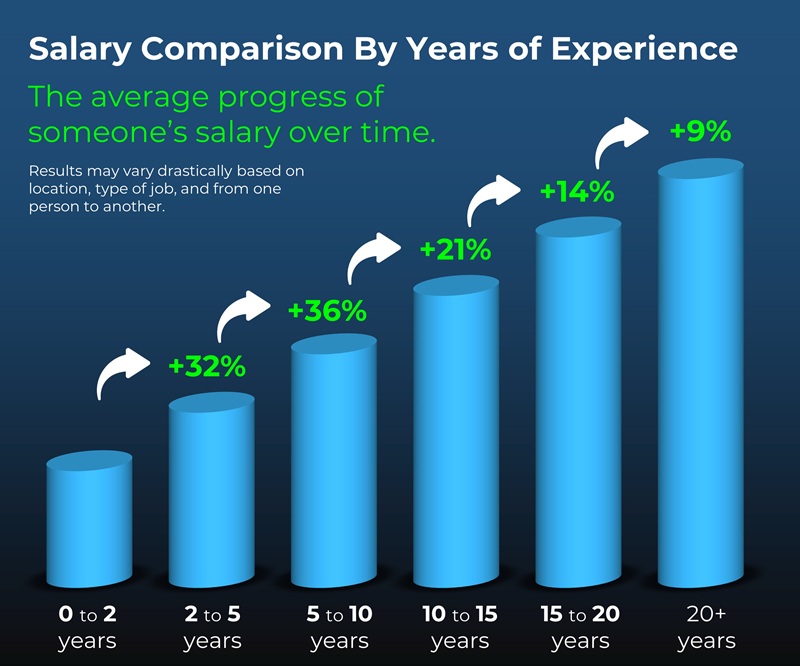
Typical Salary Progress for Most Careers
Salary Comparison By Education / Policy Change Director / Ireland
How do education levels affect salaries?
Displayed below is the average salary variance between different education levels of professionals working as Policy Change Director.
| Bachelor's Degree | 52,700 EUR | |
| Master's Degree | +53% | 80,400 EUR |

We all know that higher education equals a bigger salary, but how much more money can a degree add to your income? We broke down salaries by education level for the position Policy Change Director in order to make a comparison.
Level 1: Bachelor's Degree
Employees at this education level have an average salary of 52,700 EUR.
Level 2: Master's Degree
At this level, the average salary becomes 80,400 EUR, 53% more than the previous level.
Is a Master's degree or an MBA worth it? Should you pursue higher education?
A Master's degree program or any post-graduate program in Ireland costs anywhere from 16,100 EUR to 48,300 EUR and lasts approximately two years. That is quite an investment.
You can't really expect any salary increases during the study period, assuming you already have a job. In most cases, a salary review is conducted once education is completed and the degree has been attained.
Many people pursue higher education as a tactic to switch to a higher-paying job. The numbers seem to support the theory. The average increase in compensation while changing jobs is approximately 10% more than the customary salary increment.
If you can afford the costs of higher education, the return on investment is definitely worth it. You should be able to recover the costs in roughly a year or so.
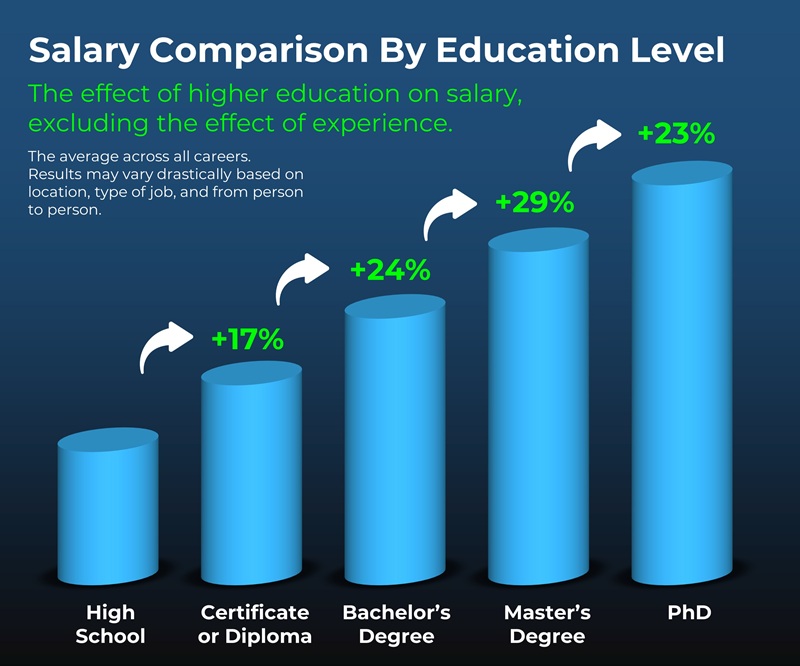
Typical Salary Difference by Education for Most Careers